|
3 Comments
Went a bit crazy on Twitter during SFN 16. Categorized them on long airport wait on way back.
Check them out: sfn16_tweets_collection.pdf Short answer: The presenter does not think about what the audience needs to hear to understand him/her. Unfortunately this is an extremely difficult skill to master - requiring one to step into the shoes of someone in the audience. But that's not even the main problem.....
We have all been there. Excited to hear the famous keynote speaker at the annual meeting of the Society for Head-Honchos, you put on your hotel alarm-clock at 5:30 AM (after spending an hour figuring out its cryptic inner workings, designed by a sadistic clockmaker). Barely awake, you stumble groggily into the gigantic dimly lit hall with elaborate chandeliers and musty carpets. After looking around stealthily to see if you know anyone (you don’t) you settle down with your coffee and fish out your notepad (that you will never see after the meeting) and the fancy pen (that you stole from the hotel front desk but will lose promptly). At least the talk will be worth it, you think. It’s not....
Over the years I have had several colleagues come to me in utter frustration that their most recent papers have been rejected from good journals. And now, after wasting all this time, they will have to make do with wherever it can get published. "How can the Reviewer/Editor not see it?" is the most common lament. In many such cases I have offered to take a look. I cannot profess that my suggestions helped these authors get their oft-rejected papers in glossy journals - though this has sometimes been the case - these experiences allowed me to get some insight into why good papers are often rejected from good journals. Allow me to elaborate....
An old but excellent Powerpoint by Rita Balice-Gordon who was at Penn (this was available online for a while so hopefully OK to share, I've added some of my own notes over the years...):
Link to Presentation This is how all of our insights come about... 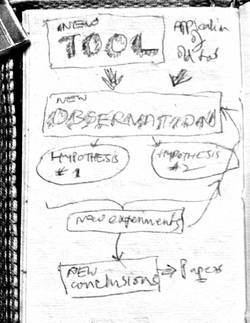 Story of the Roy lab (probably not unusual). What starts as a small cute paper eventually bludgeons into a behemoth that can probably be split into two or more papers, but its not.....hardly the best strategy, but scientifically satisfying.
....generated some good discussion on publication practices
http://biorxiv.org/content/early/2015/07/11/022368 It is astonishing how many scientists - even well-established ones - don't know how to write. The only book one needs to read is "on writing well" by William Zinsser. What's the excuse?
My takes from this book, relevant to scientists: 1. Writing is a craft, and like any craft it can be learned. 2. Good writing = good thinking. Muddled brains write muddled sentences. 3. There needs to be "joy" while writing. If you feel the drudgery, your reader will too. Usually you will need to force yourself to be joyful. Apparently most good writers do this. 4. In the end all writing is for yourself. Though you want to have a general audience in mind, you cannot write to specifically impress the editor or reviewer (a "rebuttal" may be the only exception). You need to write for yourself. 5. This is the most important thing to realize.....IT'S HARD WORK. Clear sentences are no accident, they are a product of innumerable revisions. |
Some old ones Reposted...8/18/13 - A Classification of PI's - find yours' in the list!
7/6/12 - Way to a "Science paper" 5/30/11 - 20/20 Hindsights 9/30/11 - Evolution of a bizzare, new Idea 11/17/2011 - Rationale for curiosty-driven research... lessons from a 4 year old 1/28/12 - "GTFM" - hilarious article on grant writing! The PI BlogThis blog exists because my wife seemed a bit tired of being the only recipient of my random pontifications on life and Science for many years; and gently encouraged me to vent in a blog instead. From time to time, I put down thoughts that occur to me as I naiively stumble through a life in Science - bestowed upon me by accident (literally!). Please keep in mind that these musings are rather obvious things of little or no use to anyone, and are certainly not personally targeted in any way, even though they are obviously derived from my experiences. OK, enough said. Archives
December 2020
Categories |

 RSS Feed